Yelp Reviews Are Now Feeding ChatGPT’s Local Picks: What This Means for Your Business
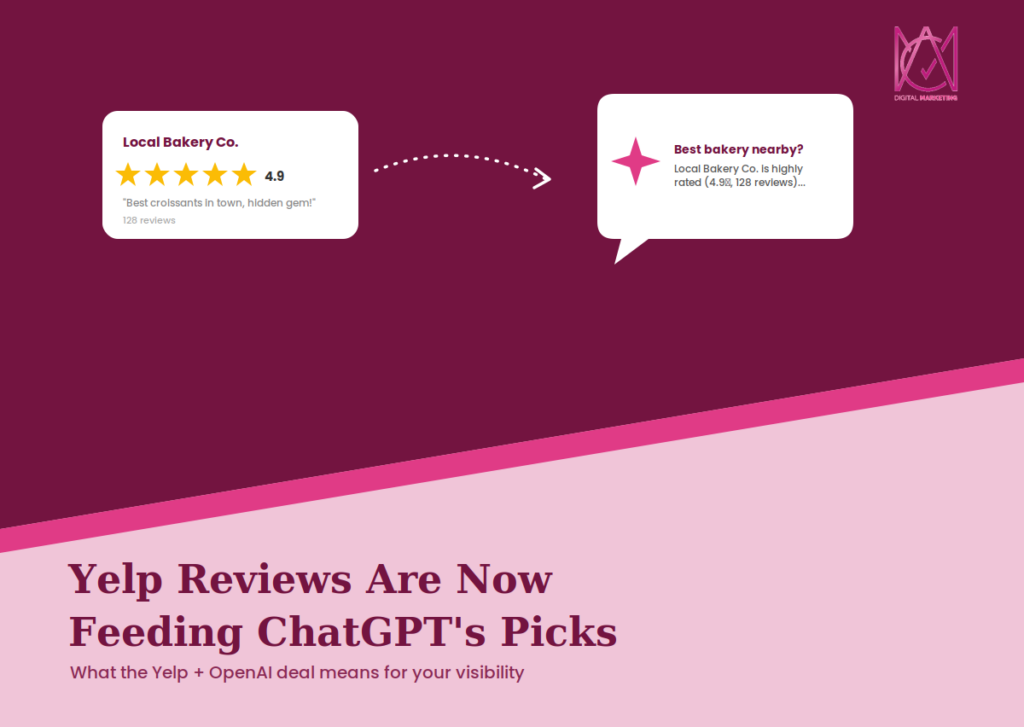
A few months ago, if a client asked us “does our Yelp page or Yelp reviews actually matter anymore?”, the honest answer was: somewhat, but it’s not where we’d focus your time. That answer just changed. Yelp has struck a deal with OpenAI, and ChatGPT can now pull directly from Yelp’s reviews, photos, and business listings when it recommends local businesses to people asking for suggestions.
If you’ve been treating your Yelp profile as an afterthought, this is the moment to reconsider that.
What Happened
According to reporting from Axios, OpenAI has entered into an agreement with Yelp to use Yelp’s aggregated reviews, photos, and business information inside ChatGPT’s local recommendation responses. In practice, that means when someone asks ChatGPT something like “what’s a good Italian restaurant near downtown” or “find me a reliable plumber in my area,” ChatGPT can now draw on Yelp’s data to answer, the same way it might reference other structured local data sources.
This lands alongside a broader shift happening across search this year: Google Search Console is now showing visibility data for third-party platforms like Instagram, YouTube, and TikTok, and AI tools across the board are increasingly pulling from multiple data sources rather than a single search index. Yelp plus ChatGPT is one piece of a much bigger pattern — AI assistants are becoming a real discovery channel for local businesses, not just a novelty.
Why It Matters And What We’re Actually Seeing
Here’s the shift we want every local business owner to sit with for a second: Google Business Profile is no longer the only listing standing between your business and a new customer. For years, the advice was simple — get your Google Business Profile right, keep it updated, collect reviews, and you’d covered the bulk of your local discovery surface. That’s no longer the whole picture.
We’re already seeing clients ask ChatGPT and similar tools about their own industries as a kind of gut-check, and the pattern is consistent: when a business’s Yelp listing is thin, outdated, or has old photos and stale information, it either doesn’t get mentioned at all or gets described in ways that undersell what the business actually offers now. Meanwhile, businesses with complete, current, well-reviewed Yelp profiles are showing up in these AI-generated answers with accurate, favorable descriptions pulled straight from their listing.
The uncomfortable part is that most business owners have no idea this is happening. Nobody gets a notification saying “you were left out of an AI recommendation.” The traffic and customers you’re not getting from this channel are invisible by nature — you don’t see the gap, you just don’t get the call. That’s exactly why we’re flagging it now rather than waiting for it to show up in a revenue conversation six months from now.
This also connects directly to something we’ve been telling clients all month: local visibility increasingly depends on your business facts being accurate and consistent everywhere — not just on your website and Google Business Profile, but across every directory that AI tools might be pulling from. Yelp just became a more important name on that list.
What We’re Telling Our Clients To Do Right Now
This is a genuinely quick win compared to a lot of the marketing work we do, which is exactly why we don’t want people to skip it.
1. Claim and audit your Yelp listing today, if you haven’t already. If you’ve never claimed your Yelp business page, that’s step zero. If you have, go look at it with fresh eyes — pretend you’re a customer who’s never been to your business. Is the information accurate?
2. Update your business hours, services, and contact details. This sounds almost too basic to mention, but it’s the single most common issue we find. Outdated hours or an old phone number don’t just annoy customers, they now risk shaping what an AI tool tells someone about you before that person ever visits your site.
3. Add current, high-quality photos. Yelp listings with old, sparse, or low-quality photos read as neglected, both to human visitors and to whatever a language model surfaces about your business. Fresh photos of your actual space, products, or work are worth the ten minutes it takes to upload them.
4. Actively collect and respond to Yelp reviews. Review volume and recency matter more now, not less. A steady flow of recent reviews signals an active, trustworthy business. Responding to reviews, especially critical ones, professionally and promptly, adds another layer of credibility that shows up in how your business gets described.
5. Make sure your Yelp info matches your Google Business Profile and website exactly. Inconsistent business names, addresses, or phone numbers across platforms create doubt for both search engines and AI tools trying to verify who you are. We treat this as a non-negotiable basic across every platform a client is listed on.
6. Check what AI tools are already saying about you. Ask ChatGPT and a couple of other AI assistants a few of the questions a potential customer might ask about your type of business, in your area. It’s a fast, informal way to see whether you’re showing up, and if you are, whether the description matches reality.
The Bigger Picture, From Where We Sit
Every time a new AI recommendation channel opens up, the businesses that benefit first are the ones who already have their basic information in order everywhere it appears. This isn’t really a new skill to learn, it’s the same discipline we’ve pushed clients toward for years: accurate, complete, current listings, wherever a customer or an algorithm might look for you. Yelp feeding into ChatGPT just raised the stakes on a task a lot of businesses had let slide.
Ten minutes cleaning up your Yelp profile this week is a small task with a genuinely open-ended upside, since you can’t yet see exactly how many conversations are happening about your business inside these tools. That uncertainty is precisely the reason to close the gap now rather than later.
For more on this update and the broader digital marketing shifts happening this month, see the full roundup here.